
If you’ve ever spent forty minutes hunting for a ghost in your code only to realize your cheap power supply had a massive voltage spike, you know that your electronics lab setup is your foundation. In 2026, a professional “desktop” isn’t just a surface; it’s a high-speed prototyping ecosystem. Whether you are a hobbyist moving into pro-territory or a hardware lead at a startup, your choice of desktop electronics tools determines how fast you move from “it’s broken” to “it’s shipping.”
At CircuitSeek, we’ve spent thousands of hours at the bench. We know that space is a premium and precision is non-negotiable. Here is the definitive list of what belongs on your desk this year.
1. The Smart Soldering Evolution: USB-C PD Stations
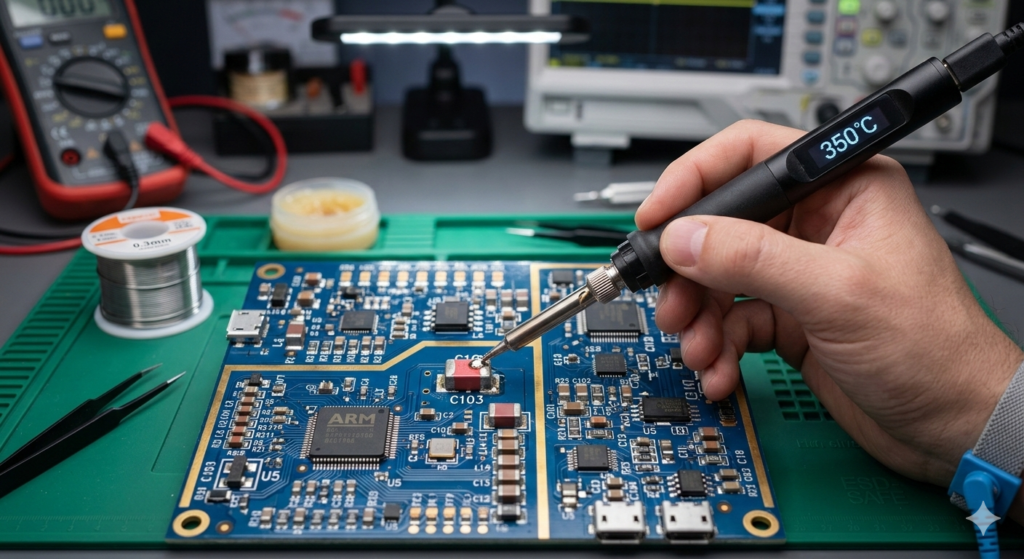
Gone are the days of the massive, buzzing transformer boxes taking up 30% of your desk. The best desktop electronics tools in 2026 are powered by USB-C.
Modern smart irons like the Pinecil or the TS101-successor series utilize Power Delivery (PD) to hit 350°C in under five seconds. They offer PID temperature control that rivals $500 JBC stations but fit in your pocket.
2. Connected Digital Multimeters (DMM)
A multimeter is your eyes. But in 2026, “just reading a number” isn’t enough. The core electronics lab equipment now focuses on data logging. We recommend DMMs with Bluetooth connectivity. Why? Because when you’re monitoring battery drain over six hours, you want a CSV file on your laptop, not a notepad and a pen.
3. High-Bandwidth Tablet Oscilloscopes
The bulky CRT-style “boat anchors” are officially dead. For a modern compact electronics workbench, tablet oscilloscopes provide the best ROI. They offer multi-touch gestures for zooming into signal noise that physical knobs just can’t match.
Essential LSI Keyword Focus: Signal Integrity
If you are working with high-speed MCU protocols like SPI or I2S, ensure your scope has at least 100MHz bandwidth and a decent sampling rate to avoid aliasing.
4. Programmable DC Bench Power Supplies
Your power supply should be “set and forget.” We favor programmable GaN-based units. They provide clean, low-ripple linear power without the heat.
- Pro Tip: Always set your Over-Current Protection (OCP) before you plug in your prototype. It’s the difference between a “pop” and a “puff of smoke.”
5. Logic Analyzers for Protocol Debugging
While a scope shows you the shape of the wave, a logic analyzer tells you what the wave is saying. For debugging I2C or CAN bus issues, a small 8-channel USB analyzer is more valuable than a $2,000 scope.
6. ESD Safety: The Invisible Shield
You can’t see a 2,000V static discharge, but your CMOS sensors can feel it. A high-quality ESD-safe mat is the most underrated tool on this list.
Note: Ensure your mat is dual-layer (dissipative top, conductive bottom) and properly grounded to the building’s earth. For deeper technical standards on ESD protection, check out theESDA (Electrostatic Discharge Association).
7. 4K Digital Microscopy
With components shrinking to 0201 sizes, your eyes need an upgrade. A desktop HDMI microscope allows for hours of soldering without neck strain.
- Check for: Large working distance (so you have room to move your iron under the lens).
8. Active Fume Extraction
Flux fumes aren’t just annoying; they are a health hazard. A compact HEPA-filtered extractor is now a standard part of any professional electronics lab setup.
9. Precision Magnetic PCB Holders
Stop chasing your PCB around the desk. A heavy magnetic base with “helping hand” arms is essential for holding probes in place while you code.
10. Digital Integration with CircuitSeek
The final tool isn’t physical—it’s how you source your parts. When a component fails during testing, you shouldn’t spend an hour browsing dead links. Use CircuitSeek to instantly cross-reference part numbers, check global stock, and find datasheets. It is the bridge between your physical bench and the global supply chain.
Data-Driven: 2026 Lab Setup Comparison
| Tool Category | “The Minimalist” (Budget) | “The Pro” (Performance) | Why it matters |
| Soldering | Pinecil V2 ($40) | JBC CD-2B ($550) | Thermal recovery |
| DMM | ANENG AN8008 ($25) | Fluke 87V ($450) | Input protection/Safety |
| Scope | Rigol DHO800 ($300) | Siglent SDS2000X ($1k+) | Vertical resolution (12-bit) |
FAQ: Setting Up Your Lab
How much space do I actually need? You can run a world-class lab on a 1.2-meter desk if you utilize vertical shelving and compact desktop electronics tools.
Are “All-in-one” lab stations worth it? Generally, no. If the scope breaks, you lose your power supply too. Stay modular.
How does CircuitSeek help my workflow? We categorize millions of parts so you can find the exact LDO or MOSFET you need without leaving your “flow state.”