
So, you’re ready to stop soldering on your kitchen table and finally build a professional electronics workbench? Whether you are a freelance firmware engineer or a hardware startup founder, your bench is more than just furniture—it’s where your ROI happens. In 2026, a “pro” setup isn’t about having the biggest, loudest vintage Tektronix scope; it’s about modularity, precision, and electronics lab infrastructure that doesn’t bottleneck your workflow.
When you start from scratch, the goal is to eliminate “friction.” Friction is that 15-minute hunt for a 10k resistor or the constant cable tangles that lead to accidental shorts. At CircuitSeek, we’ve analyzed thousands of BOMs and lab setups to understand what actually moves the needle for engineering productivity.
Phase 1: The Foundation – Ergonomics and ESD Infrastructure
Before you buy a single instrument, you need to handle the “boring” stuff that keeps your components alive.
Selecting Your Lab Bench Surface
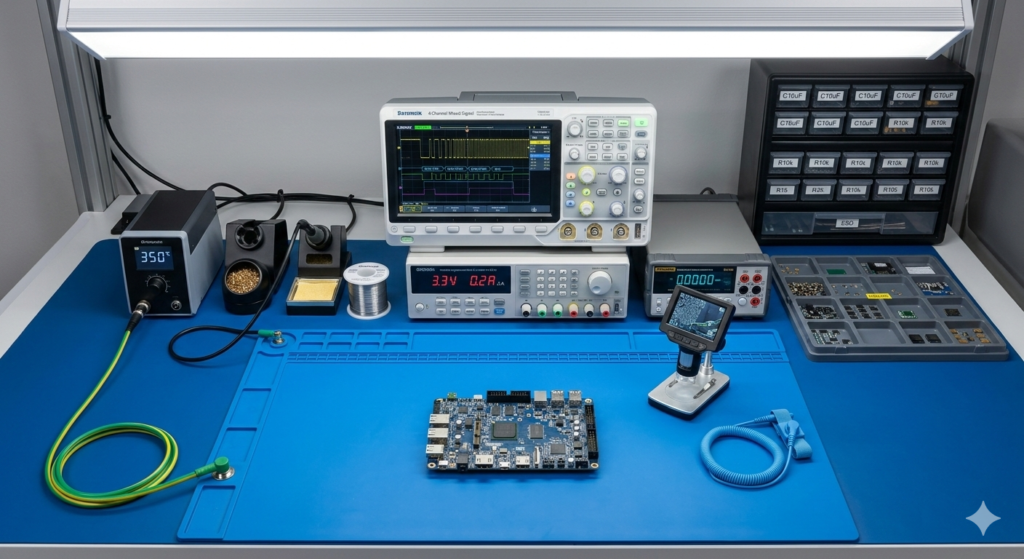
A standard office desk won’t cut it. You need a heavy-duty frame that can handle the weight of linear power supplies without wobbling. More importantly, you need a dedicated ESD-safe workspace. We recommend a dual-layer dissipative mat bolted directly to a common ground point. Static is the silent killer of the modern 1.2V logic chips we use today.
Phase 2: Essential Electronics Lab Equipment for 2026
Building your professional electronics lab requires a balance between “Buy it for Life” (BIFL) quality and modern connectivity.
Smart Soldering and Rework
In 2026, bulky transformer-based soldering stations are being replaced by high-density USB-C PD soldering irons. They offer incredible thermal recovery and take up zero permanent desk space. For SMD work, a compact hot-air rework station is no longer optional—it’s a requirement for 0402 and QFN packages.
The Modern Signal Chain: Scopes and Analyzers
If you’re building IoT devices, your scope needs to be “protocol aware.” Look for a 4-channel mixed-signal oscilloscope (MSO) that can decode I2C, SPI, and CAN bus out of the box.
- Pro Tip: If you’re on a budget, a high-quality USB-based logic analyzer paired with a mid-range scope is often more powerful than a single high-end standalone unit.
Phase 3: Power and Precision
You can’t troubleshoot a “brown-out” issue with a noisy, cheap power brick.
H3: Programmable DC Power Supplies
Modern silicon is incredibly sensitive to ripple voltage. A professional bench needs a programmable DC power supply with ultra-low noise. High-resolution current monitoring (down to the micro-amp range) is essential for optimizing battery life in wearable tech.
Phase 4: Data-Driven Blueprint (Budget vs. Performance)
Not everyone has a corporate-funded budget. Use this table to prioritize your “from scratch” spending.
| Component | Essential (Entry Level) | Professional (Mid-Tier) | Expert (High-End) |
| Workbench | DIY Wood + ESD Mat | Dedicated Lab Table | Motorized Sit-Stand |
| Soldering | Pinecil / TS101 | Hakko FX-951 | JBC / Metcal |
| Visuals | 10x Head Magnifier | 1080p HDMI Scope | 4K Digital Microscope |
| Safety | Desktop Fan | Carbon Filter Box | Fume Extractor Arm |
Phase 5: Digital Integration with CircuitSeek
A professional workbench is only as good as its inventory management. There is nothing more frustrating than being in “the zone” only to realize you’re out of 0.1uF decoupling caps.
This is where CircuitSeek becomes your 11th tool. By integrating your local inventory with our real-time search engine, you can verify part availability and find pin-compatible alternatives before you even heat up your iron. For a deep dive into the industry standards for electronic component reliability, refer to the IPC (Association Connecting Electronics Industries).
FAQ: Setting Up Your Pro Lab
- Do I need a 4-channel scope? For 2026 standards, yes. Debugging SPI (Clock, MOSI, MISO, CS) requires all four channels simultaneously.
- How do I manage cable clutter? Use under-desk cable trays and “shorty” BNC cables for your benchtop instruments.
- What is the best lighting? High-CRI LED panels. If your CRI is low, you won’t be able to tell the difference between a red and an orange resistor band.