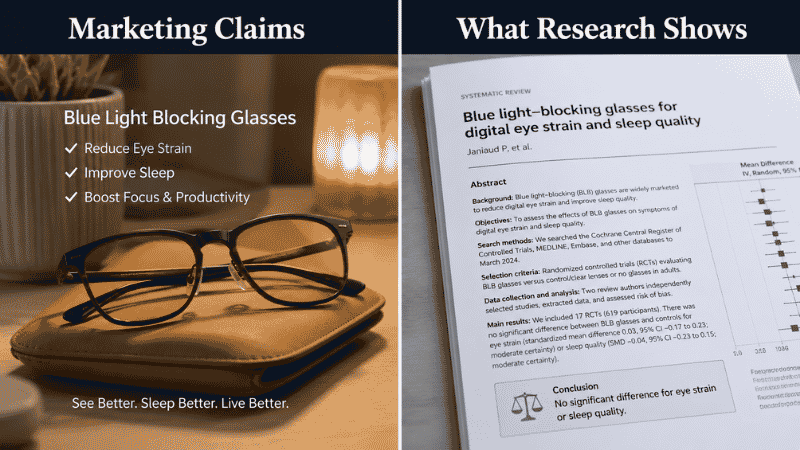
You probably bought them — or at least considered it.
The ad found you at the right moment: eyes tired from a long screen day, maybe a headache building behind your temples. The promise was clear and appealing. These glasses filter out the harmful blue light from your screens, reduce eye strain, help you sleep better. They looked good. They weren’t that expensive. You bought them.
Or maybe you didn’t buy them, but you’re wondering if you should. Either way, you have the same question most remote workers eventually ask: do blue light glasses actually work?
The honest answer, backed by the most rigorous research available as of 2026, is: probably not — at least not for the reasons they’re marketed. But the story is more interesting than a simple yes or no, because it leads directly to understanding what is actually causing your eye strain, and what actually helps.
This article walks through the evidence, the real cause of screen-related eye discomfort, and what to do about it — whether or not you own a pair of blue light glasses.
Key Takeaways
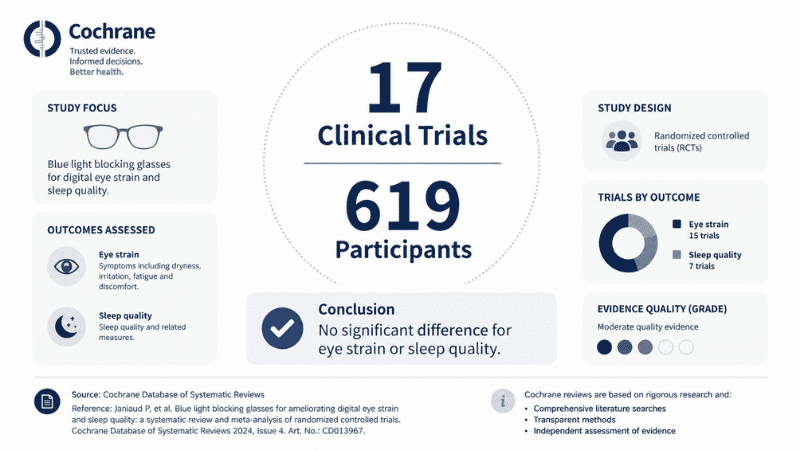
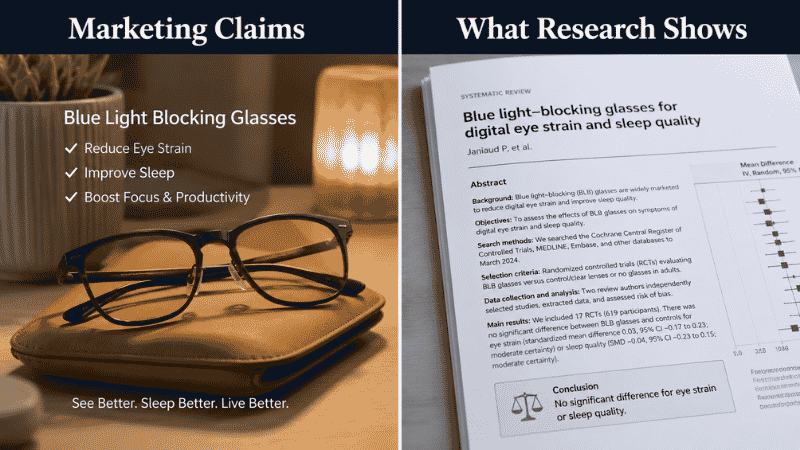
- The 2023 Cochrane systematic review — the gold standard of medical research — analyzed 17 randomized controlled trials involving 619 participants and concluded that blue light filtering lenses “probably make no difference” to eye strain or sleep quality during screen use
- Eye strain from screen work is primarily caused by reduced blink rate (dropping from 15–20 blinks/minute to 5–7) and sustained near-focus — neither of which blue light glasses address
- The global blue light glasses market reached $3.5 billion in 2025 despite weak scientific evidence — a gap between commercial success and clinical reality that’s worth understanding before spending $30–$200 on a pair
- Blue light glasses may have a legitimate use case for one specific situation: worn 1–2 hours before bedtime, they may modestly reduce melatonin suppression and support better sleep onset
- The evidence-based alternatives — 20-20-20 rule, screen brightness adjustment, and monitor position — address the actual causes of eye strain and cost nothing
What the Research Actually Shows About Blue Light Glasses
Let’s start with the science, because this is where the conversation usually goes wrong.
The 2023 Cochrane review is the most comprehensive analysis of blue light glasses published to date. Cochrane reviews are considered the highest standard in medical evidence — they systematically analyze all available randomized controlled trial data rather than cherry-picking favorable studies. This one examined 17 trials across six countries with 619 participants.
The conclusion, stated clearly: blue light filtering spectacles “probably make no difference to eye strain, eye health, or sleep quality” compared to regular lenses.
This isn’t a fringe finding. The American Academy of Ophthalmology does not recommend blue light glasses for eye strain prevention. Multiple independent systematic reviews have reached similar conclusions. The researchers noted their findings “do not support the prescription of blue-light filtering lenses to the general population.”
The market reality is striking by comparison. Global blue light glasses sales reached $3.5 billion in 2025. A 2018 Australian survey found that 75% of optometrists prescribed these lenses despite acknowledging the evidence limitations. The commercial momentum has significantly outpaced the clinical evidence.
None of this means blue light glasses are harmful. They’re not. They just appear not to deliver the benefits they’re marketed for — at least not for eye strain during work hours.
Why Your Eyes Are Actually Tired (It’s Not the Blue Light)
If blue light isn’t the main problem, what is?
Eye doctors and vision researchers consistently point to two mechanisms that explain most screen-related eye discomfort — and neither of them involve light wavelength.
The blink rate problem. When you’re focused on a screen, you blink significantly less than normal. Studies measure this consistently: the typical resting blink rate is 15–20 times per minute. During concentrated screen use, this drops to 5–7 times per minute. Blinking is how your eyes distribute tear film across the eye surface. Blink less and tear film evaporates faster, leaving eyes dry, irritated, and fatigued. Blue light glasses do nothing for your blink rate.
The accommodation problem. Your eye’s lens constantly adjusts to maintain focus at different distances — a process called accommodation. When you stare at a screen at a fixed distance for hours, the ciliary muscles that control this focus hold the same position continuously. Like any muscle doing sustained isometric work, they fatigue. The result is that familiar tired, slightly blurry, aching feeling that comes after long screen sessions. Again, filtering blue light doesn’t change the accommodation workload.
This is why you can wear blue light glasses all day and still have tired eyes by 4 p.m. — because the glasses are addressing a different variable than the one causing the problem.
One eye doctor interviewed by a major health publication summarized it plainly: “When you stare at your digital device, two things happen: you don’t blink as much, and your eyes must focus harder. Blinking less leaves eyes dry and itchy, while focusing too hard causes headaches, fatigue, and blurred vision.” Both of those problems are independent of blue light wavelength.
Do Blue Light Glasses Help with Eye Strain? The Nuanced Answer
The flat answer is: current evidence says no. But there’s a nuanced version worth understanding.
Some people report genuine subjective improvement when wearing blue light glasses. This isn’t necessarily placebo — there are a few possible explanations.
The glasses may change how people behave around screens. Putting on a pair of glasses you associate with “eye protection” might make you more conscious of your screen habits — taking more breaks, sitting slightly farther from the monitor. Those behavioral changes could produce real benefits, even if the optical filtering is doing nothing.
Some people have light sensitivity conditions — migraines, traumatic brain injury, certain neurological conditions — where filtering high-energy visible light provides genuine comfort improvement. This is a specific population, not a general one.
And the anti-reflective coating that comes with many blue light glasses can reduce glare — which is a real contributor to eye discomfort. The glare reduction may be producing benefits that get attributed to the blue light filtering.
So if you own blue light glasses and feel they help: they might be helping through one of these mechanisms. The optical filtering of blue light specifically is not what the evidence supports — but that doesn’t mean nothing about the glasses is useful.
When Blue Light Glasses Might Actually Help: The Sleep Case
Here’s where the evidence is less dismissive.
Blue light does suppress melatonin production — this is well established. The mechanism is that blue wavelength light activates photoreceptors in the retina that signal the brain’s circadian system to suppress melatonin, which is the hormone that initiates sleep onset.
During daylight hours, this is a feature: it’s part of how your circadian rhythm stays calibrated to the light-dark cycle. The problem is that screens emit blue light in the evening, when your body expects the light environment to be shifting toward warmer, lower-energy wavelengths. This can suppress melatonin and delay sleep onset.
For remote workers who use screens heavily in the evening — whether finishing up work, watching shows, or scrolling — blue light glasses worn in the 1–2 hours before bedtime may modestly support melatonin production and help with sleep quality. This is the one specific use case where the mechanism is more plausible.
The practical alternative that achieves the same thing without buying glasses: enable night mode or warm display (lower color temperature) on your devices during evening hours. Most phones and computers have this built in. It’s free and achieves a similar wavelength shift.
What Actually Helps with Eye Strain at Work
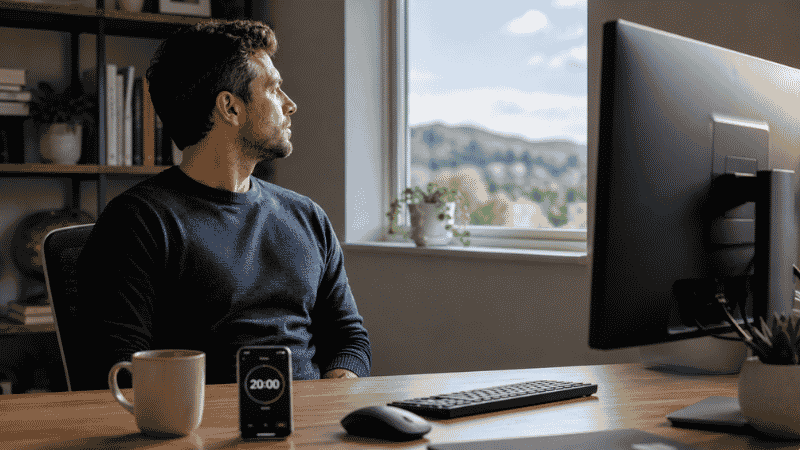
If blue light glasses probably aren’t the answer, what is? The evidence-based interventions for screen-related eye strain are less photogenic but significantly more effective.
The 20-20-20 rule. Every 20 minutes, look at something at least 20 feet away for at least 20 seconds. This forces your ciliary muscles to shift from near-focus to distance-focus, releasing the sustained accommodation that causes fatigue. Multiple clinical studies support this as the primary behavioral intervention for digital eye strain. It’s free. The American Academy of Ophthalmology recommends it.
Blink intentionally. Sounds almost too simple, but it works. During screen use, consciously remind yourself to blink fully and regularly. A full blink — where your eyelids fully close and reopen — properly redistributes tear film. The half-blinks most people make during screen focus are less effective. If dryness is your primary symptom, artificial tears used occasionally during the workday provide immediate relief.
Match screen brightness to the room. When your screen is significantly brighter than the surrounding environment, your pupils constantly adjust as your gaze moves between the screen and other surfaces. Over hours, this constant micro-adjustment is genuinely fatiguing. Adjust screen brightness so it’s roughly the same brightness as your ambient environment — not brighter, not significantly dimmer.
Monitor position. The top of your screen should be at or slightly below eye level. Looking up at a screen increases the exposed area of your eye surface and accelerates tear evaporation. Looking slightly downward positions your eyelids to cover more of the eye naturally, reducing evaporative dry eye.
Reduce screen glare. A matte screen protector, repositioning your monitor away from window glare, or a desk lamp that doesn’t reflect in the screen all reduce the glare that contributes to visual fatigue. This is the environmental change that’s most commonly overlooked.
Should You Buy Blue Light Glasses?
The honest framework:
If you want to buy them for eye strain during work hours: The evidence doesn’t support expecting significant benefit. If you already own a pair and find them comfortable, wear them — they’re not harmful. But don’t expect them to solve the problem.
If you want to buy them for better sleep: There’s a more plausible mechanism here. If you use screens heavily in the 1–2 hours before bed and have difficulty sleeping, glasses with warmer lenses worn during that window may help. So will enabling night mode on your devices — which is free.
If you want the most effective use of money for eye comfort: Spend nothing — implement the 20-20-20 rule consistently. If you want to spend something, a matte screen protector ($15–20) reduces glare, which is a real contributor to eye discomfort that’s worth addressing.
If you do want blue light glasses specifically — perhaps for the anti-reflective coating, the aesthetic, or the behavioral reminder to be mindful of screen time — they’re inexpensive enough that reasonable options exist at $20–40. The Gunnar Optiks line is the most established brand in this space. Felix Gray is popular for a more polished aesthetic. The functional difference between a $25 pair and a $150 pair is probably not measurable for most users, since the filtering itself isn’t doing much heavy lifting.
If You Only Have 10 Minutes Right Now
Don’t buy anything. Set a 20-minute timer on your phone right now. When it goes off, look at the wall across the room for 20 seconds. Then reset it. Do this for the rest of your workday.
Also: when did you last consciously blink fully? Do it now. A few deliberate full blinks. Your eyes probably needed that.
That’s the actual intervention. It costs nothing and addresses the real causes.
When to See an Eye Doctor
Blue light glasses won’t substitute for a professional evaluation if your eye discomfort is significant or persistent.
See an eye doctor if you experience eye strain symptoms consistently despite good screen habits, particularly if you also notice vision changes (blurring, difficulty focusing on distant objects), pain rather than just fatigue, headaches that accompany or follow screen use regularly, or any eye symptoms that don’t resolve with rest. These may indicate refractive errors (needing glasses or updated prescription), dry eye disease, or other conditions that benefit from treatment.
Persistent digital eye strain in someone who works at screens for 8+ hours daily is also worth mentioning at a routine eye exam — an optometrist can evaluate whether screen-specific glasses with anti-reflective coating, anti-fatigue lenses, or occupational prescription might genuinely help your specific situation.
FAQs
Do blue light glasses work for eye strain? Based on current evidence — specifically the 2023 Cochrane systematic review of 17 clinical trials — blue light filtering lenses probably make no significant difference to eye strain compared to regular lenses. The primary causes of screen-related eye strain are reduced blink rate and sustained near-focus, not blue light exposure.
Are blue light glasses worth it? For eye strain during work hours: probably not, based on the research. For evening use before bed: there’s a more plausible case for modest sleep benefit. For general comfort or anti-reflective coating benefits: possible, but the same effects are available from standard anti-reflective lenses without the blue light filtering premium.
Do blue light glasses help with sleep? More plausibly than for eye strain, but the evidence is still limited. Blue light does suppress melatonin, and wearing filtering lenses 1–2 hours before bed may modestly support sleep onset. Night mode on devices achieves a similar effect for free.
What actually helps with eye strain from screens? The 20-20-20 rule (every 20 minutes, look 20 feet away for 20 seconds), deliberate blinking, matching screen brightness to room lighting, ensuring your monitor is at or slightly below eye level, and reducing screen glare. These address the actual mechanisms behind digital eye strain.
Are blue light glasses harmful? No. They’re not harmful. They just appear, based on current evidence, not to provide the benefits they’re most commonly marketed for — particularly for eye strain during screen work.
The Honest Conclusion
Blue light glasses have become a $3.5 billion industry built on a premise that the best available science doesn’t cleanly support. That’s worth knowing before you spend money on them.
The causes of your eye strain are real. The afternoon fatigue, the dryness, the headaches — those are genuine symptoms of a genuine problem. The problem just isn’t blue light. It’s a blink rate problem and an accommodation problem, and those respond to behavioral changes, not optical filters.
Implement the 20-20-20 rule. Blink more deliberately. Position your screen correctly. Reduce glare. These aren’t as satisfying as buying something, but they work.
And if you want to wear blue light glasses anyway — for the aesthetic, for the reminder they provide to take screen breaks, or for evening use — that’s fine. They’re not going to hurt you. Just know what you’re actually getting.
Related Articles on CircuitSeek
- Eye Strain Relief for Remote Workers →
- Best Headphones for Working from Home →
- Adjustable Laptop Stand for Desk →
- The Complete Home Office Setup Guide →
- Desk Organization Ideas That Actually Stick →
References
- Lawrenson, J.G., Shah, R., Huntjens, B., et al. (2023). Interventions for myopia control in children: A living systematic review and network meta-analysis. Cochrane Database of Systematic Reviews. The blue light glasses component: https://www.cochrane.org/about-us/news/blue-light-filtering-spectacles-probably-make-no-difference-eye-strain-eye-health-or-sleep
- American Academy of Ophthalmology. (2023). Computers, Digital Devices and Eye Strain. https://www.aao.org/eye-health/tips-prevention/computer-usage
- Sheppard, A.L., & Wolffsohn, J.S. (2018). Digital eye strain: prevalence, measurement and amelioration. BMJ Open Ophthalmology, 3(1), e000146. https://doi.org/10.1136/bmjophth-2018-000146
- Ostrin, L.A. (2019). Ocular and systemic melatonin and the influence of light exposure. Clinical and Experimental Optometry, 102(2), 99–108.